
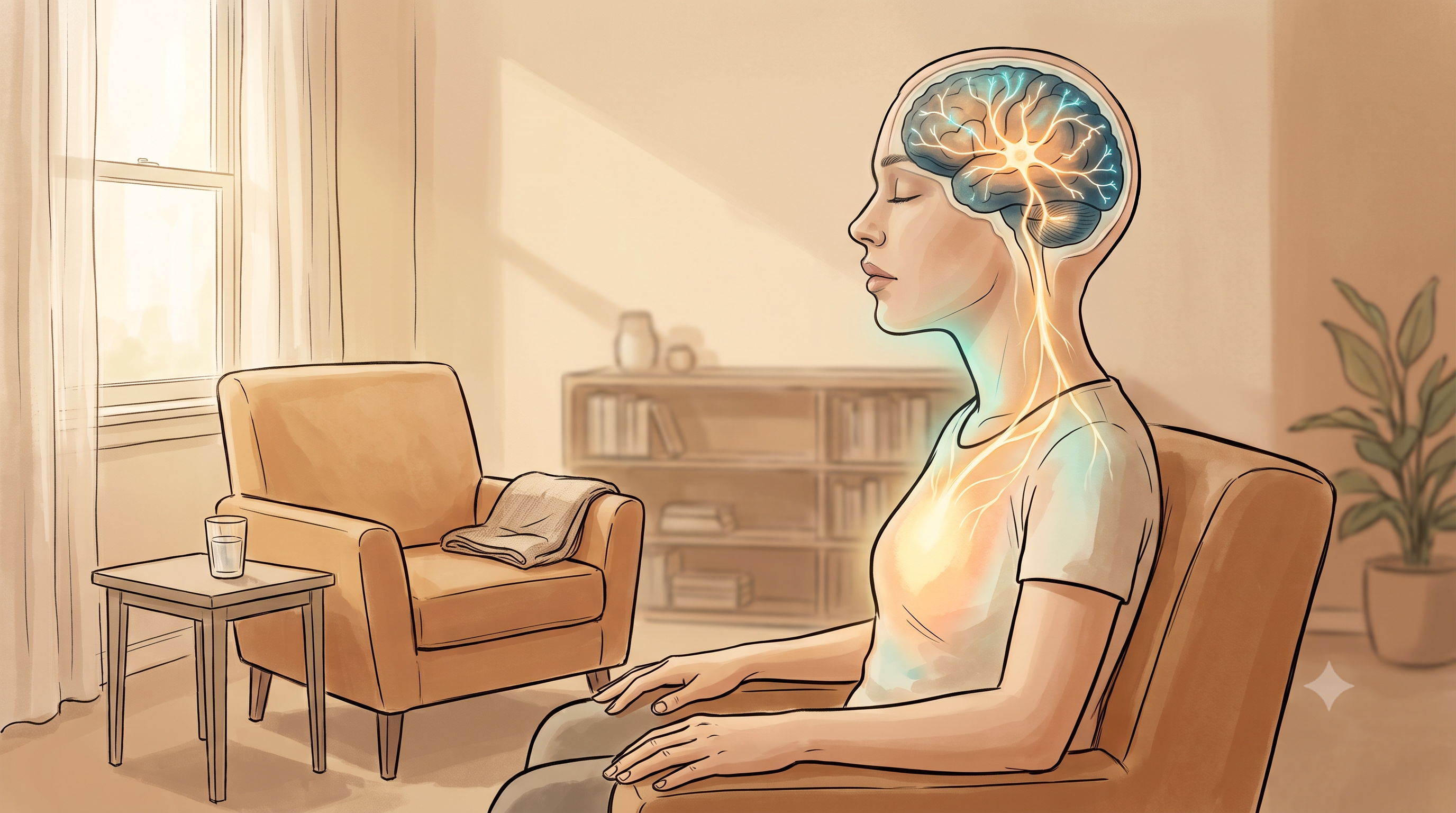
You can spend your entire life living everywhere except where you actually are. The mind is a relentless traveler. It packs its bags the moment you wake up. It builds elaborate, terrifying futures that will never actually happen. It reconstructs past conversations so you can finally win arguments that ended years ago. It plans. It regrets. It judges. It escapes. The mind is always in motion. But while your thoughts wander across decades and continents, your physical form remains completely stationary. The body is the one place that is always exactly here. It knows only the present moment. Mindfulness is simply the practice of noticing that you have left, and choosing to come back home to the body.
This act of returning is not a modern clinical invention. The root of this practice traces back to the Satipatthana Sutta roughly 2500 years ago. The entire framework was built on a very simple, mechanical reality. It was built on attention to the breath. The breath is the perfect anchor because it only happens right now. You cannot breathe in the past. You cannot breathe in the future. The body breathes only in the current second. Whenever you realize your mind has traveled decades into the future, the physical sensation of inhaling brings you instantly back to the only moment that actually exists.
Years later, teachers like Thich Nhat Hanh taught this mindful breathing and extended it far beyond the meditation cushion. He brought it into the most ordinary moments of daily life. He applied it to dishwashing and to tea drinking. He understood that you do not need a sacred space to find presence. You only need to inhabit the physical reality of the moment. As he said, "Mindfulness allows you to live deeply every moment that is given you to live."
From the Monastery to the Clinic
For centuries, this practice lived primarily within monasteries and spiritual communities. It required a specific type of architect to translate that profound depth into a structure that the medical world could utilize. That translation happened at the University of Massachusetts Medical School in 1979. Jon Kabat-Zinn founded the Stress Reduction Clinic there. As a Professor of Medicine emeritus with a PhD in molecular biology from MIT, he possessed the exact rigorous background needed to bridge these worlds. He applied Buddhist practice directly to patients suffering from severe chronic pain. These were individuals who had fallen through the cracks of conventional medicine. Their bodies felt like unbearable prisons. They spent all their mental energy trying to escape their physical reality. Kabat-Zinn taught them how to safely inhabit those bodies again.
The clinical structure he built is now known as Mindfulness-Based Stress Reduction. Today, over 700 hospitals worldwide offer MBSR to their patients. The founding hypothesis, in the Center's own words, was elegantly simple: the practice of mindfulness could help alleviate the pain and suffering associated with chronic disease.
Returning to the Sensation, Not the Story
When I sit in the clinic with a person in pain, my goal is to help them find that same anchor in the body. The fusion of mindfulness into therapy requires a distinct shift in perspective. Traditional Cognitive Behavioral Therapy restructures a thought. That is highly valuable work. It examines the logic of a fear and dismantles it. But mindfulness does something entirely different. It changes your relationship to a painful feeling, rather than trying to change the content of the feeling itself.
I see this constantly in my daily practice. A client will sit on the sofa and begin to spin a complex, terrifying narrative about their life. Their words speed up. Their breathing becomes shallow. Their mind has completely left the room and is currently living in a projected disaster three months from now. If I try to argue with their narrative, I am just joining them in the labyrinth. The intellect tries to solve an emotional flood by building a dam of logic, but it rarely holds.
Instead, I ask them to pause. I ask them to stop talking about the story and simply locate the feeling in their physical form. I ask them where the anxiety lives right now. Usually, it is a tightness in the chest, a knot in the stomach, or heat rising in the neck. I guide them to focus entirely on that physical sensation. I ask them to breathe into it without trying to push it away. This is the hardest part of the work. The natural instinct is to reject the pain. I ask them to just let the body hold the sensation. Slowly, the physical intensity peaks and then begins to subside. The mind realizes the body is safe. The person comes back home to the room. They return to the present moment.
Clinical Lineages That Share One Principle
This approach of separating the observer from the overwhelming experience connects deeply with other distinct clinical lineages. Internal Family Systems, for instance, relies heavily on this exact type of self-observation. In IFS, you view the mind not as a single monolith, but as an ecosystem of distinct parts. You might have a manager part that works exhaustingly to prevent failure, or an anxious part that carries old burdens. IFS teaches you to identify the anxious part without becoming consumed by it. You anchor yourself in the core observing presence, what IFS calls the Self. From that anchored place, you can look at the terrified part with compassion, rather than being hijacked by its panic. You watch the part react, but you stay rooted in the body.
Dialectical Behavior Therapy utilizes a similar mechanism through a different lens. It was built for individuals experiencing profound emotional dysregulation. You cannot simply tell someone in agony to change their thoughts. They have to radically accept the reality of the agony first. DBT teaches non-judgmental observation as a core distress tolerance skill. When emotional pain spikes, DBT instructs you to observe the emotion exactly as it is. You do not label it as good or bad. You do not rush to fix it.
While IFS and DBT are completely separate theoretical frameworks, they both rely on the fundamental mindfulness principle of stepping out of the mental noise and resting in direct, non-reactive awareness. You gain distance. You watch the mind travel, but you decide to keep your feet planted firmly on the ground. You do not judge the mind for traveling. You simply notice the departure and gently guide your attention back to the physical sensation of sitting in the chair.
The Resistance Is Part of the Practice
When I first introduce this practice to someone in the clinic, the immediate reality is rarely peaceful. I ask a person to close their eyes. I ask them to stop managing their life for five minutes. I ask them to simply notice the physical sensations in their body. Almost instantly, a profound resistance rises to the surface. The mind absolutely hates being confined to the present moment. It feels like a cage. The legs become restless. The skin suddenly itches. The breathing feels manual, awkward, and restricted. There is an overwhelming, nearly magnetic urge to open the eyes. There is an urge to get up, to check a phone, to solve a problem, to do absolutely anything other than sit still.
The person will often look at me and say they are failing. They tell me their mind is too loud. They say their anxiety is spiking, and this practice clearly does not work for them. But this intense rebellion is exactly what they need to see. The resistance itself is part of the practice. It is not a sign of failure. The urge to escape the physical form is the very mechanism of suffering being exposed in real time. When you sit and feel the agonizing itch to run away, and you choose to stay in the chair, you are finally doing the work. You are watching the mind pack its bags, and you are refusing to buy the ticket. The practice is not about achieving a state of glassy calm. The practice is noticing the desperate desire to be somewhere else, and choosing to remain in the body anyway. It is the slow, deliberate conditioning of the nervous system. It teaches the brain that staying present will not destroy you. You learn to observe the panic without becoming the panic.
Asaf Federman from IDC Herzliya, now Reichman University, calls this the healing paradox of controlled behavior. When you try to exert direct self-control over an emotion, it backfires. The struggle to suppress the feeling only amplifies the suffering. But non-judgmental acceptance actually increases real self-regulation. You gain agency through acceptance, not through willpower. You stop trying to manipulate the experience. You simply let the body hold it, knowing the body is strong enough to weather the physical sensation of the emotion.
Spiritual Depth and Clinical Rigor
This integration of clinical structure and contemplative depth has deeply influenced my own path. My earlier Hebrew writing on this topic was directly inspired by the book "Mindfulness, Here and Now, Theory and Practice," published by Keter in 2018 and recognized as a bestseller. The editor and co-writer of that foundational book is Maty Lieblich. She is the co-founder and academic director of the Mindfulness Based Psychotherapy program at the Bar Ilan University School of Social Work. She also co-founded CCME, the Center for Compassionate Mindful Education. With thirty years of personal practice and twenty years of teaching, she has been instrumental in building the academic container for mindfulness in Israel. Her work proves that spiritual depth and clinical rigor can coexist perfectly.
Looking the Science Straight On
Because I value intellectual honesty, I must look at the science of mindfulness with absolute clarity. It is very easy to get swept up in the romantic idea that meditation acts like a magic wand for your neuroanatomy. For years, the scientific community has tried to map exactly how this practice alters the human brain. The wellness industry desperately wants simple, highly shareable narratives about brain rewiring. People want a physical cure for a non-physical pain, and colorful brain scans look wonderfully definitive.
An early, smaller study conducted by Holzel at Harvard in 2011 provided exactly that kind of narrative. It suggested that MBSR increases hippocampal gray matter. It was a beautiful story that fit perfectly onto magazine covers and wellness blogs. The idea that sitting quietly could literally build new brain tissue was incredibly appealing. However, clinical truth requires a willingness to look at the full picture, even when it complicates the story.
A much larger and more rigorous study published in 2022 by Kral in Science Advances, involving 218 participants, did not confirm this increase in gray matter. I state this plainly because true therapy rests on facts, not comforting illusions. Depth without structure collapses, and relying on outdated or exaggerated science weakens the structural foundation of the work. If you build a therapeutic practice on a promise that a brain scan will magically change in eight weeks, you set people up for failure.
Yet, the clinical efficacy of the practice rests on incredibly strong ground. Even if the physical architecture of the brain does not drastically change in eight weeks, the behavioral outcomes are undeniable. Mindfulness-Based Cognitive Therapy, developed by Williams, Teasdale, and Segal and now studied at the Oxford Mindfulness Centre, is a proven and highly effective method to prevent depression relapse. The structured application of MBSR across those 700 hospitals consistently shows profound results for chronic pain and stress. The practice reliably improves attention across diverse populations. What matters in the clinic is not whether an fMRI machine detects more gray matter, but whether a person can finally breathe through a panic attack without losing their anchor to physical reality.
Returning, Again and Again
In my practice, I see exactly what this method treats. It treats anxiety. It treats chronic pain. It treats attention deficits. It is specifically designed for depression relapse prevention. But beneath all these clinical labels, it treats the secondary suffering that comes from abandoning the present moment.
Anxiety pulls your mind into a terrifying future. Depression drags your mind into a heavy past. Chronic pain makes your mind desperate to escape the physical reality of the present. In every one of these conditions, the mind packs its bags and leaves the physical location of the self. The therapeutic work is the slow, repetitive process of coming back. It is not about achieving a state of eternal bliss. It is about realizing you have wandered off, and choosing to return.
The mind will always try to travel. It will build new futures to fear and dig up old pasts to regret. That is simply what minds do. But healing begins the moment you stop following your thoughts into the labyrinth. You do not need to become someone else. You only need to notice where you are. The body is waiting exactly where you left it. It is the only place that is always here.